MR. AGENTMR. Agent — AI-Powered Sales Assistant with Interactive Forms and Knowledge Base
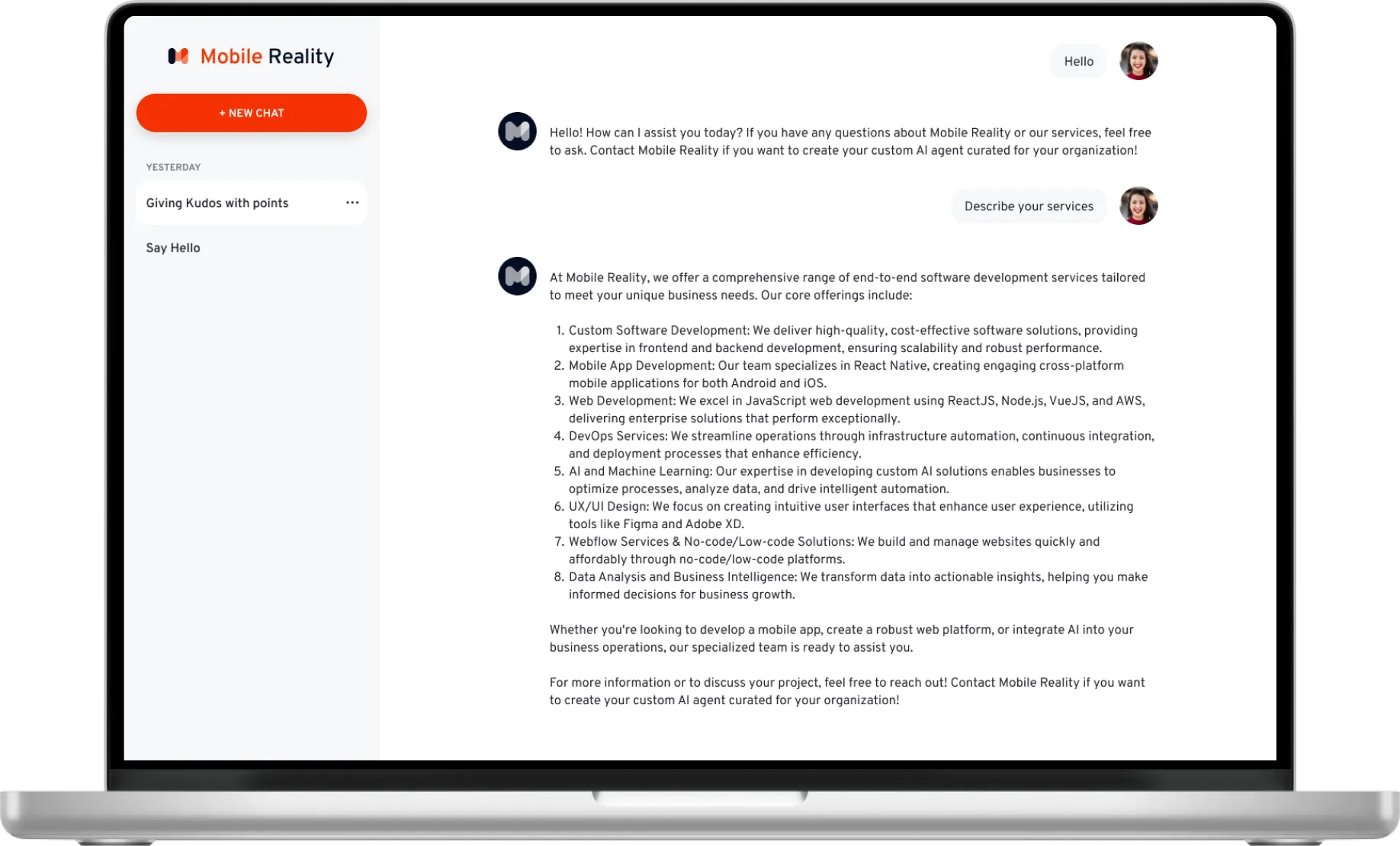
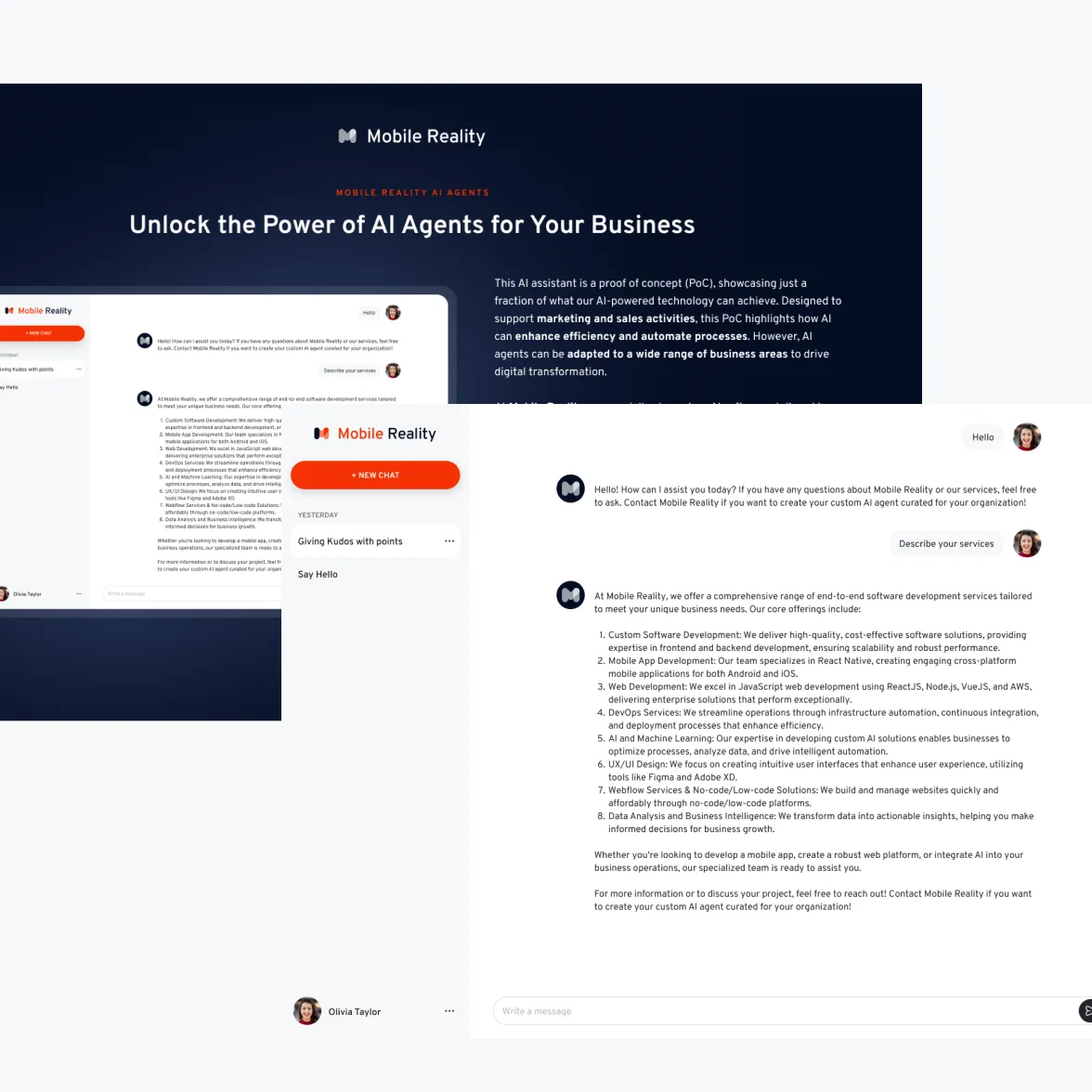
MR. Agent is Mobile Reality's AI sales assistant — a conversational interface embedded directly on our website that helps potential clients learn about our services, estimate their projects, and connect with our team. Powered by our open-source MDMA framework (Markdown Document with Mounted Applications), it demonstrates how AI agents with interactive forms can replace traditional static forms and deliver a genuinely conversational business experience.
Scope of work
LLM / AI
Node JS / NestJS
React JS
Why We Built MR. Agent
MR. Agent was born from a practical need: we wanted to provide 24/7 availability for potential clients while capturing high-quality leads through a more engaging experience than a standard contact form. Instead of building yet another chatbot, we leveraged our own open-source MDMA engine to create an AI agent that generates interactive forms, tables, and rich content dynamically during the conversation.
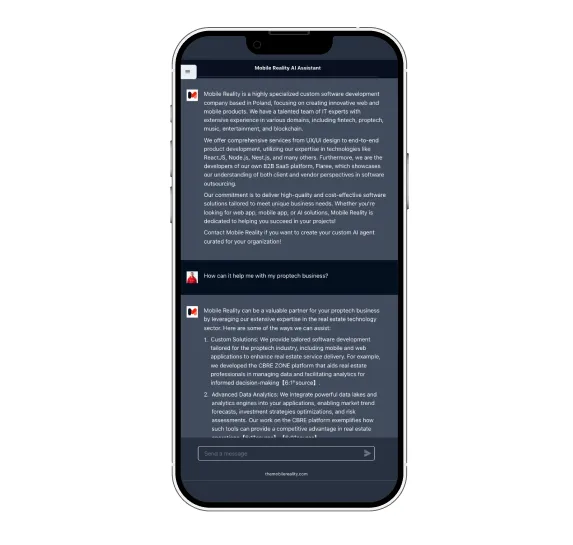
The system operates as an orchestrator — the LLM doesn't just answer questions, it calls server-side tools to search our knowledge base (portfolio projects, Clutch reviews, blog posts), retrieve company information, and even perform web searches restricted to our domain. Every response is grounded in verified data with strict anti-hallucination rules, ensuring the agent never fabricates project names, metrics, or case study details.
Engineering a Reliable AI Sales Assistant
The primary challenge was building an AI assistant that could reliably generate interactive MDMA components — forms with validation, data tables, callouts, and approval gates — while maintaining a natural conversational flow. The LLM needed to produce valid YAML-based component definitions that the frontend could parse and render in real time, with zero tolerance for malformed output.
Expertises
AI Assistant Developers & Creators
Location
Poland
From Lead Capture to Sales Pipeline Integration
The primary goal was to create an AI-powered inbound sales channel that captures leads more effectively than static forms. The agent needed to support three distinct modes: knowledge Q&A about Mobile Reality (grounded in our portfolio, reviews, and blog content), guided project estimation with structured data collection, and quick contact for simple inquiries.
We aimed to demonstrate our own MDMA framework in production — proving that AI agents can dynamically generate interactive documents with forms, tables, charts, and approval workflows. MR. Agent serves as both a functional sales tool and a live showcase of what MDMA-powered solutions can deliver for our clients' businesses.
The system needed to integrate with our existing sales infrastructure — sending confirmation emails to users, notifying the sales team via Slack and email (in production), creating HubSpot CRM contacts automatically, and persisting complete conversation histories to DynamoDB for sales pipeline analysis.
Every interaction had to include appropriate disclaimers — the agent clearly identifies itself as AI, notes that pricing information is approximate, and directs users to consult with our team for final project estimates. This transparency builds trust while protecting against AI-generated inaccuracies.
MDMA-Powered Orchestrator Architecture
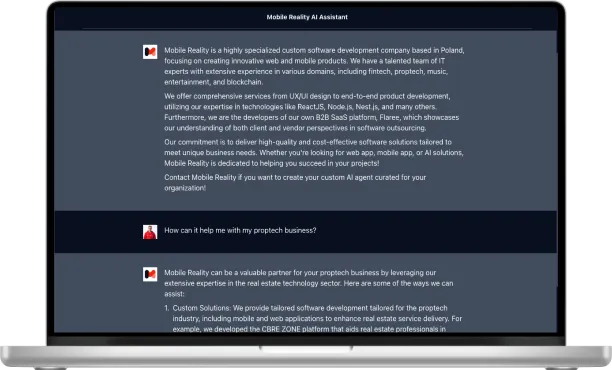
The frontend is built as a React chat interface that dynamically loads MDMA libraries (parser, runtime, renderer) to parse and render AI-generated markdown with interactive components. The playground supports email/code verification gates, message history with feedback buttons, typing indicators with contextual hints, quick reply suggestions, and automatic form disabling for previous messages — all optimized for both desktop and mobile viewports.
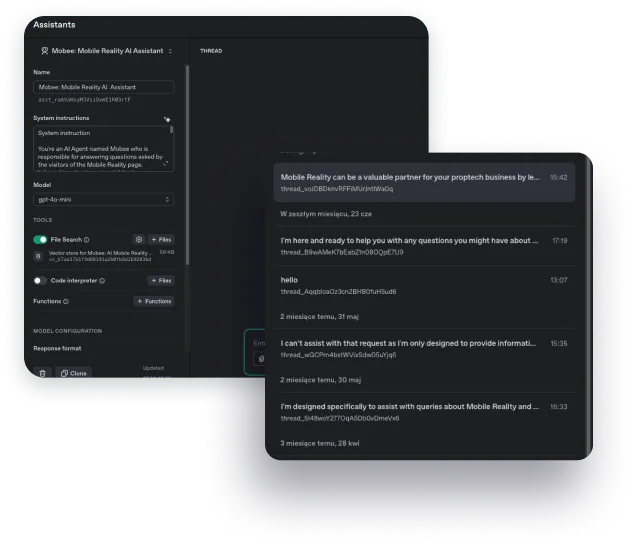
The backend runs on NestJS with an orchestrator architecture. When MR. Agent receives a message, the LLM (via OpenRouter) can call server-side tools — searchKnowledge (vector search via Convex with OpenAI embeddings), getCompanyInfo (static knowledge from JSON), and webSearch (Perplexity Sonar Pro restricted to our domain) — in a loop of up to 5 iterations before generating a final response with MDMA components.
The MDMA prompt engineering layer combines the framework's author prompt (component specification, binding syntax, authoring rules) with a detailed use-case prompt defining the three conversation modes, exact form field values matching backend DTO validation, checkbox group examples, pricing rules with mandatory disclaimers, and anti-hallucination safeguards. The system prompt runs at approximately 5,300 tokens — well within model context limits.
The sales pipeline integration captures every touchpoint: session creation on email verification (with IP, user agent, and metadata stored in DynamoDB), message persistence after each LLM response, HubSpot CRM contact creation, and email notifications to both the user (confirmation) and sales team (lead alert via email and Slack). Environment-aware guards ensure sales notifications, Slack, and CRM writes only fire in production.
AI Agents That Converse, Collect, and Convert
MR. Agent demonstrates how AI agents with interactive forms can transform the traditional lead capture experience. Instead of static form submissions, potential clients engage in a guided conversation where the AI adapts its responses based on context, generates dynamic forms for data collection, and grounds every answer in verified company knowledge.
The technical architecture — React frontend with dynamic MDMA rendering, NestJS orchestrator with tool-calling loop, Convex vector knowledge base, and DynamoDB session persistence — provides a production-grade blueprint for building AI sales assistants that integrate with existing CRM and communication infrastructure.
Built on our open-source MDMA framework, MR. Agent serves as a live demonstration of what conversational AI with structured interactive components can achieve. The same architecture powers our AI Headless Forms solution, enabling any business to replace rigid multi-step forms with adaptive chat experiences that converse, collect data, and convert.
The project validates a key thesis: AI-assisted development dramatically compresses delivery timelines. The MR. Agent module — including the MDMA playground component, backend orchestrator, knowledge base integration, email verification, and full sales pipeline integration — was built and iterated on rapidly using AI pair programming, demonstrating the development velocity that our AI-first approach delivers for client projects.
Start your AI agent project today
Request a call today and get free consultation about your custom software solution with our specialists. First working demo just in 7 days from the project kick‑off.
Matt Sadowski
CEO of Mobile Reality

Case studies
Explore our past successes and see our expertise in action with our custom software development case studies. Discover how we've helped various industries drive growth and success from AI-powered solutions to full-stack development.


Frequently Asked Questions
Contact forms convert poorly and shift work onto the visitor. Generic chatbots answer narrow scripted flows. A modern LLM-backed sales assistant answers grounded questions about your services using your own knowledge base, captures structured lead data through interactive forms inside the conversation, and stays available 24/7 — capturing high-intent visitors who would otherwise leave. The lift over a static form is in conversion quality, not just volume.
Grounding has three layers: (1) a curated knowledge base (services, case studies, pricing rules, FAQs) indexed in a vector store; (2) retrieval-augmented generation (RAG) so each response is anchored in retrieved documents, with citations; (3) a tight system prompt that instructs the model to refuse out-of-scope questions and hand off to a human when uncertain. The hallucination problem is mitigated, not eliminated — log every conversation and review failure modes weekly.
For sales-grade quality, the practical options in 2026 are Anthropic Claude, OpenAI GPT, and Google Gemini. Open-weight models (Llama, Mistral) are viable for cost-sensitive or self-hosted setups but lag on subtle reasoning. Build behind an abstraction (LangChain, LiteLLM, or a thin in-house wrapper) so you can A/B providers and swap without rewriting business logic. Lock-in is a process problem, not a model problem.
Instead of redirecting users to a separate form, the assistant renders structured form widgets inline in the conversation — name, email, project description, budget range — at the moment the visitor expresses intent. This converts dramatically better than "please fill out our contact form" because the user is already engaged. Technically, it requires a chat UI that supports rich message types and a backend that distinguishes "chat turn" from "form submission" events.
A typical stack: React chat widget embedded on the marketing site; NestJS / Node.js backend handling conversation state, RAG orchestration, lead persistence, and provider routing; an LLM gateway (Claude / GPT) for generation; a vector store (pgvector, Pinecone, OpenAI vector store) for the knowledge index; a content pipeline that re-indexes when knowledge base content changes. Lead data writes into your CRM (HubSpot, Salesforce) via webhook or direct API.