Software Creation Process
How we build software: AI agents, human judgment, and 10 years of craft
Technology is no longer the bottleneck. AI lets us pick up any stack on demand. What sets software apart now is the process: how it is planned, built, reviewed, and shipped. We pair AI agents with our own engineering harness and a decade of codified best practices to deliver high-quality software, fast and predictably.










How we build
A closed loop of AI-assisted planning, agent-driven development, and rigorous human review, backed by skills crafted over ten years of shipping production software. What you see here is a portion of what we are able to do.
Compass: an AI agent that keeps Jira up to date
Compass works from the whole project context: tasks synced from Jira, code from the project repositories, and a project brain that keeps key facts and decisions. The agent does not guess, it drafts from what is actually in the project.
The PM asks in the chat for a new task, a label, or a release, and the agent drafts it in the format the team already uses. The PM can ask for changes or edit the draft by hand, and nothing reaches Jira without the PM's approval.
Lantern: review every change an agent makes
Lantern shows every agent session in one place and flags the moment one needs a developer. When an agent finishes a change, Lantern opens its pull request on the project's architecture map, with the files in review order and one sentence on why each one changed.
We see which parts of the system a change touches before we accept it, and line comments go back to the agent as one instruction. The agent proposes, the developer decides, so quality is verified on every change, not hoped for at the end.
Skills: ten years, codified
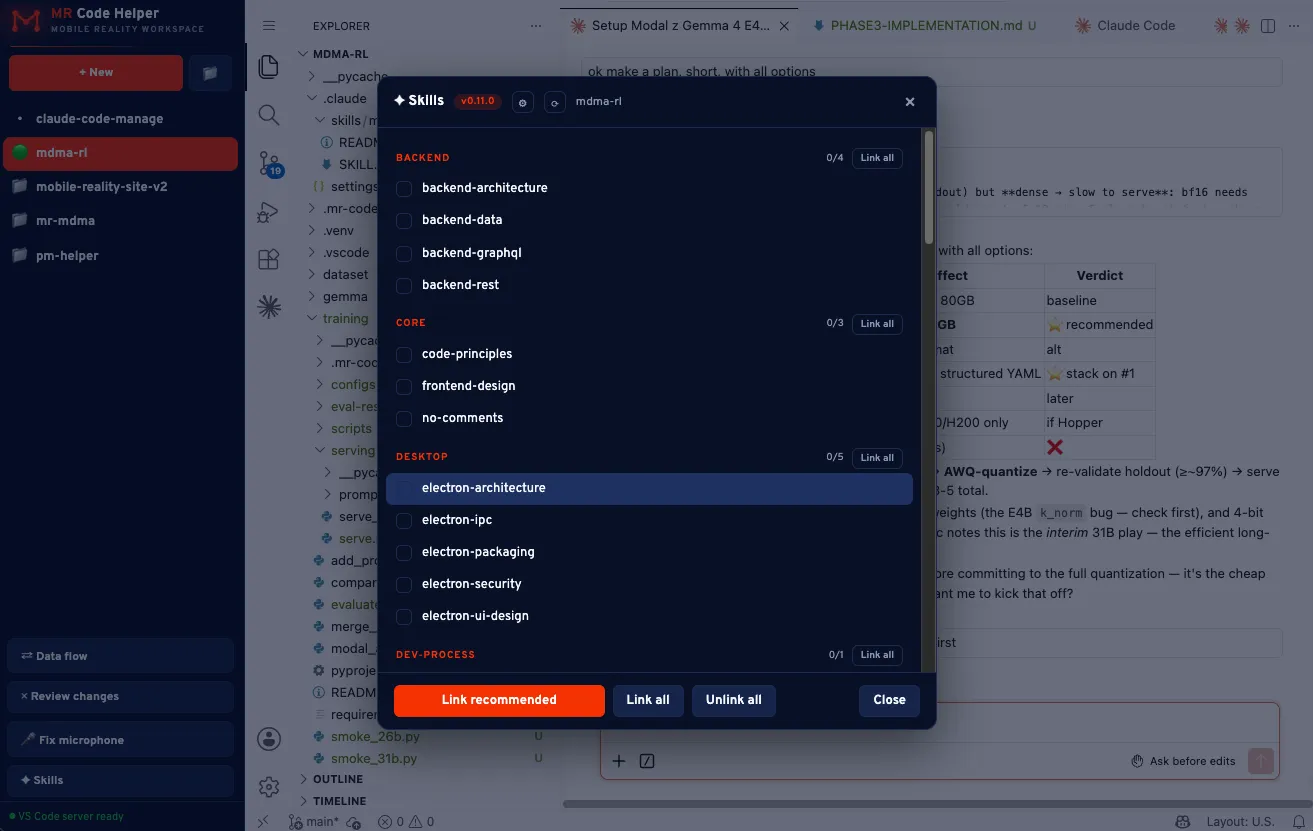
Our agents are guided by a curated library of skills: backend, frontend, mobile, desktop, cloud, dev-process, and more. Each one captures how we build, not just what we build.
These skills capitalize a decade of software development into repeatable best practices, so every project starts from our highest standard instead of from scratch. The same engineering rigor then applies across the stack we work in.



I've worked in tech for years and this shop has your best interest in mind.
CEO & Brand Strategist, HeresMe Agency
Tech stack
In Mobile Reality we use JavaScript, top-notch and trusted technologies as React.JS, Node.JS, Vue.JS, React Native, AWS to deliver the high quality digital products. We also leverage advanced AI tools including OpenAI, Anthropic, LangChain, Langfuse, and Meta Llama to integrate intelligent automation and LLM capabilities into our solutions.
The team behind AI agents that cost a fraction to run
We build production-ready AI agents for business and the custom software around them, on production-proven stacks: React, Node.js, TypeScript, React Native, and AWS. Cost per task is a design decision we make up front, not a clean-up job later: the right-sized model for each step instead of a frontier model for all of them, multi-model routing across OpenAI, Anthropic, Google, and open-weight LLMs, structured output that smaller models produce reliably, and caching where it earns its keep.
Eval suites prove the leaner path did not degrade the work, so lower spend never means worse results. Where the volume justifies it, we fine-tune a small open-weight model on your task and deploy it on your infrastructure: you own the weights, your data stays inside your boundary, and the bill stops growing with usage. Engineers, AI specialists, UX/UI designers, and QA work as one team from architecture to deployment, with a focus on fintech, proptech, and SaaS.
Explore our technological audit solutions
Our strategy is supported by a combination of people and technology. Led by individuals with the will and expertise to change the world. And strengthened by cutting-edge JavaScript technologies, AWS cloud solutions and QA and UX/UI expertises.
Find out howTools that We Love to Use
Start your AI agent project today
Request a call today and get free consultation about your custom software solution with our specialists. First working demo just in 7 days from the project kick‑off.
Matt Sadowski
CEO of Mobile Reality