AI Forms & Generative UI for LLM Chat
AI Forms That Your LLM Renders, Not Describes
Stop parsing walls of text out of your AI chat. AI Headless Forms give your LLM a spec it can answer in — so it returns a real form, table, or approval gate your app renders instantly. Built on MDMA, our open-source generative UI format: model-agnostic, framework-agnostic, and you own every byte of data.
Scroll down
to learn more.
Not a Black Box. Read the Source.
AI Headless Forms are powered by MDMA (Markdown Document with Mounted Applications) — our open-source generative UI engine that lets any LLM answer with interactive components instead of plain text. MIT-licensed, published on npm, and built in the open, so you can audit exactly what runs in your product before you commit to it.
Who Benefits from AI Headless Forms?
Higher conversion rates, lower support costs, faster time-to-market, and complete data sovereignty. AI Headless Forms deliver measurable business impact across every department that touches your customer journey.
Growth & Product Leaders
Challenge: Every form iteration burns engineering cycles and slows down revenue experiments. A/B tests that should validate in hours take weeks to ship.
Impact: Change a flow by editing a prompt and a Markdown block instead of shipping a release. Run experiments in days, not sprints, and get to a validated conversion path far sooner.
Engineering & Platform Teams
Challenge: Every AI feature ends up with its own bespoke UI and its own brittle parser for whatever the model returned. Scaling that across departments, regions, and compliance rules creates bottlenecks.
Impact: One validated schema for every interactive AI response. Ten component types, an open spec, and renderers for React, Vue, and React Native — so teams ship independently on shared infrastructure instead of rebuilding the same layer.
Customer Experience Leaders
Challenge: Complex multi-step forms drive abandonment. Users drop off when they don't understand fields, and static tooltips aren't enough.
Impact: Transform forms into guided conversations. Users get instant, contextual answers — boosting completion rates, reducing drop-offs, and elevating your brand's perceived quality.
Founders & Business Owners
Challenge: High form abandonment directly impacts revenue. Support teams waste time answering repetitive form-related questions instead of closing deals.
Impact: Self-service forms that convert more users with zero support overhead. AI guides every customer to completion — increasing revenue per visitor while cutting operational costs.
See AI Headless Forms in Action
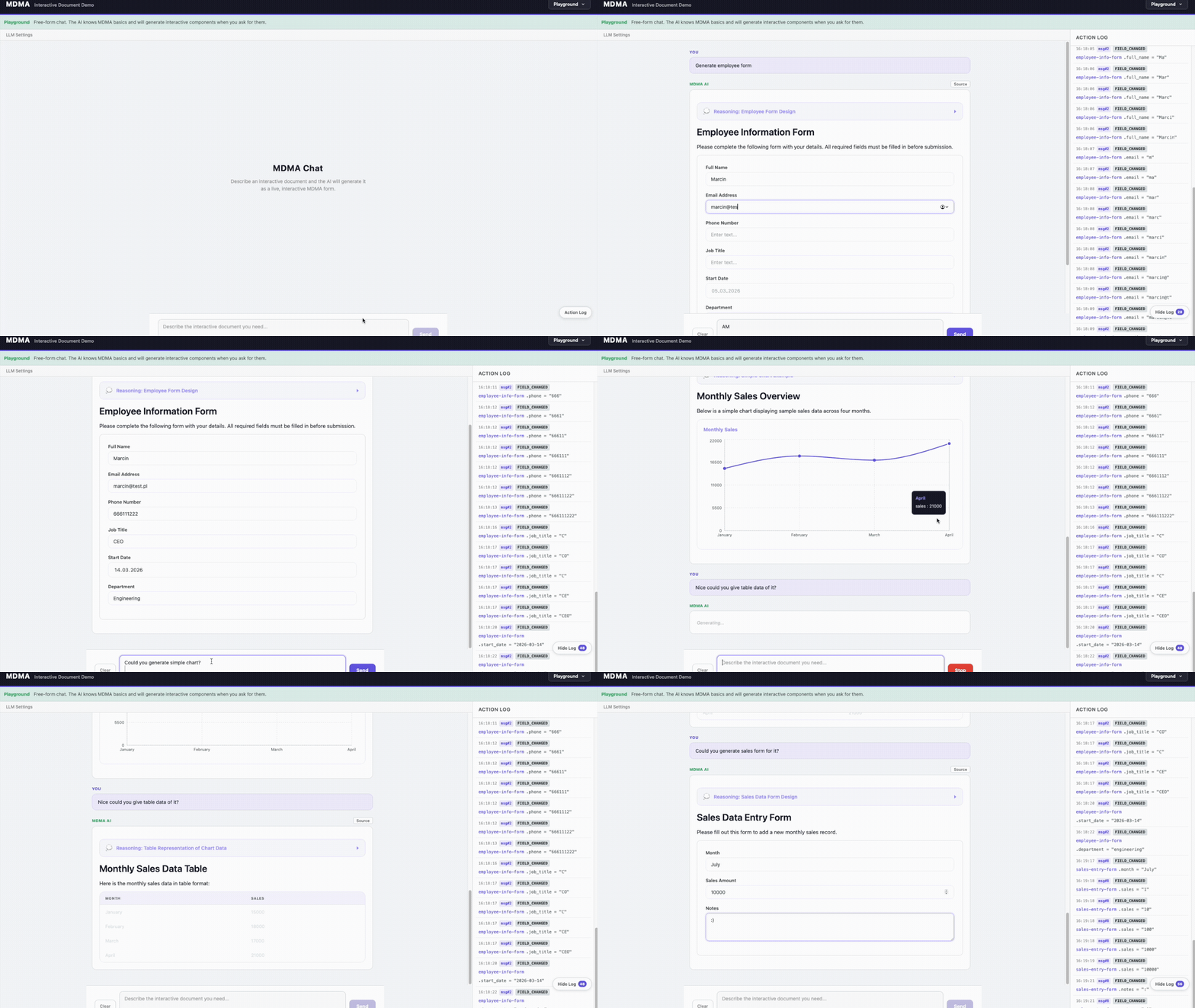
See MDMA in Action
Explore our interactive case study showcasing how MDMA powers a real-world KYC/AML verification workflow — with AI-generated forms, document verification tables, compliance checklists, and approval gates.
Try the Interactive DemoMDMA Beyond Fintech
The same ladder of form, evidence table, checklist and approval gate carries an industrial workflow. Walk through how a vision detection or telemetry alert on an off-highway machine becomes an approved action with a hash-chained audit record behind it.
Try the Machine Agent DemoTen Components Your AI Can Return
A form is the entry point, not the ceiling. The same spec covers every interactive element an AI answer might need — so one integration serves your whole product, not a single flow.
Form
Text, number, email, date, select, checkbox, textarea, and file fields with validation, required flags, and sensitive (PII) markers.
Table
Typed columns and row data — document checklists, order lines, escalation history, anything better read than described.
Chart
Data visualisation inside the conversation. Ships as a lightweight table fallback; plug in your own chart renderer to keep bundle size yours to decide.
Approval Gate
Approve / deny workflow gates with pending, approved, and denied states — the building block of every multi-party sign-off.
Tasklist
Interactive checklists that track prerequisites and hold a process open until the required steps are actually done.
Webhook
Trigger a backend action from inside the document, with idle, executing, success, and error states rendered to the user.
Button
Primary, secondary, and danger action buttons wired to named actions instead of free-text instructions.
Callout
Info, warning, error, and success banners so the AI can flag risk visually rather than burying it in a paragraph.
Thinking
Collapsible reasoning blocks — show the AI's chain of thought when transparency matters, hide it when it doesn't.
Custom
A stable escape hatch for anything the built-ins don't cover. Register your own component and the AI can call it by name.
Blueprints for Regulated Workflows
Forms are where teams start. The workflows below are working, open-source blueprints in the MDMA repository — multi-step processes where a wrong answer is a compliance incident, not a bad UX.
Finance & Compliance
KYC / AML Case Review
Identity verification with PII-flagged fields, a document verification table, and a compliance approval gate before a case can be cleared.
Engineering & Compliance
Change Management
SOX/ISO release approval — risk assessment, dual approval, and a pre-deploy checklist that has to be complete before the gate opens.
Critical Operations
Incident Triage
Severity assessment, stakeholder notification, resolution tracking, and closure gated behind an explicit sign-off.
Healthcare
Clinical Procedure Approval
Clinical and QA review with safety verification steps before a procedure is published to staff.
Customer Operations
Customer Escalation
SLA-aware escalation with sentiment tracking and a dynamic escalation-history table that grows as the case moves.
HR Operations
Employee Onboarding
Personal details, equipment selection, and a manager checklist — one conversation replacing a chain of emails and PDFs.
Why AI Headless Forms?
Traditional forms are static, fragile, and frustrating. AI Headless Forms are adaptive, conversational, and built for the next generation.
Forms are flexible — adjust, extend, or shrink them by writing text. A/B testing won't take days to prepare. It will take a few sentences.
Like headless frontend — our library builds the foundation but UI can be whatever you like. Bring your own design system, framework, and components. Renderers ship for React, Vue 3, and React Native.
AI generates the foundation but never stores your data. You can provide any context to the AI, but you own every byte — no vendor lock-in, no mandatory data sharing. The whole engine is MIT-licensed open source and can run entirely on your own infrastructure.
Users interact with complex forms via chat — they can ask questions, request clarifications, see examples. No more tooltips. No more help articles. AI handles it all.
Modern users prefer self-service over calling support. With AI Headless Forms, every user can handle any process independently — and when they need help, AI guides them.
Simple forms are straightforward, but stepper forms get confusing after 2 steps. AI guides users through every dependency between inputs, keeping track of your preferences and business rules.
Need to persuade users with data inside a form? Traditional forms offer limited options. Our AI provides relevant data, draws charts, and creates tables on demand.
Worried about AI accuracy? Every generated block runs through a static validator with 17 lint rules — YAML correctness, schema conformance, unique IDs, binding syntax, PII flags — and six auto-fix strategies repair what the model got wrong before anything reaches the user. When a block still fails, a dedicated fixer prompt repairs it on the fly.
Built for Regulated Environments
The reason conversational forms stall in enterprise isn't the UX — it's the audit question. Everything below is in the engine, not on a roadmap.
Tamper-Evident Audit Trail
Every event — field change, submission, approval, denial — lands in an append-only log with hash chaining, so you can prove what a user saw and what they agreed to.
Automatic PII Redaction
Fields with PII-like names are detected and flagged automatically, then hashed, masked, or omitted from the event log according to your policy.
Policy Engine
Allow and deny rules per action and per environment. A webhook that fires in production stays inert in staging unless you say otherwise.
Runs In Your Infrastructure
MIT-licensed, no hosted runtime required, no telemetry to opt out of. Deploy on-prem or in your own cloud with the model provider of your choice — including a self-hosted one.
No Runtime JavaScript in Documents
Documents are Markdown plus YAML, parsed deterministically. A model-generated document can't execute code in your app — it can only describe components your renderer already trusts.
Works With Your Model — Not Just Ours
The generation quality of an AI form depends on the model behind it. We test that rather than assume it.Continuously Evaluated Across Providers
Automatic Repair of Bad Output
Our Own Fine-Tuned Model
Agent-Ready Tooling
How We Deliver AI Headless Forms
From discovery to production — a streamlined process to get your AI-powered conversational forms live.
01
Discovery & Design
We analyze your existing forms, map user journeys, define form steps, validation rules, and the conversational layer — then design the AI instructions and data flow.
02
Headless Integration
Connect the AI engine to your frontend stack. You build the UI layer with your design system while our SDK handles form logic, state management, and the chat interface.
03
Testing & Tuning
Run the validator against your flows, evaluate the prompt across candidate models, tune it for your domain, and verify the conversation end to end with real user scenarios.
04
Launch & Iterate
Go live with monitoring and analytics. Use natural language to iterate on form flows, review user conversations for insights, and continuously improve completion rates.
Key Capabilities
Everything you need to build intelligent, conversational forms.
Natural language form configuration
Conversational chat interface for users
React, Vue & React Native renderers
Static validation with auto-repair
Built-in charts, tables & rich data
Audit trail & automatic PII redaction
MDMA Open Source Insights
Read our latest articles about the MDMA open source project by Mobile Reality — AI-powered form engine, architecture deep-dives, and integration guides.
28.07.2026
Generative UI: How AI Builds User Interfaces on Demand
Learn how generative UI builds personalized, reliable interfaces from trusted components with 1,377 tests revealing best formats for robust production use.
Read full article
31.07.2026
AG-UI Protocol Explained: How It Compares to MDMA
Explore how AG-UI protocol streams 17 event types for real-time AI agent interaction, contrasting with MDMA's Markdown-based generative UI content format.
Read full article
07.10.2026
Top Generative UI Frameworks 2026: A Developer's Guide
A developer's guide to generative UI frameworks in 2026: Vercel AI SDK, CopilotKit, Tambo, A2UI, AG-UI, json-render, and MDMA, with how each generates user interfaces.
Read full article
31.07.2026
JSON Render vs MDMA: Why the MD Format Might Be the Better Choice for Generative UI
Compare json-render's JSON tree and MDMA's Markdown approach for AI-generated UIs to boost reliability, ease multi-turn edits, and simplify developer reviews.
Read full article
31.07.2026
Conversational AI with Interactivity
Explore how conversational AI with MDMA enables real-time interactive responses like forms and buttons, boosting customer action completion by integrating dialogue and workflows seamlessly.
Read full article
31.07.2026
MDMA AI Sales Assistant 2026: Boost Leads 30%, Own Your Forms
Boost sales leads by 30% with MDMA AI forms, dynamic, context-aware chat forms that capture cleaner data and reduce funnel drop-offs seamlessly.
Read full article
15.04.2026
Conversational Forms: MDMA vs Traditional Frontend Development
Compare MDMA conversational forms with traditional frontend development. Better user engagement, chat-like interactions, and a superior user experience for your forms.
Read full article
31.07.2026
AI Form Builder: Cut Dev Time 80% with MDMA vs Retool vs Custom
Cut dev time by 80% using MDMA to generate AI-powered forms dynamically, compare it with Retool and custom UI for cost, compliance, and flexibility in 2026.
Read full article
31.07.2026
Markdown for AI Agents: Build Interactive Agents Fast 2026
Build interactive AI agents with markdown for AI agents using MDMA. Deploy a mortgage pre-approval agent in 5 minutes with real example code and zero fluff.
Read full article
17.09.2026
Google A2UI vs MDMA 2026: Cut AI UI Token Costs 16%
Cut AI UI token costs by 16% using MDMA's Markdown vs Google A2UI JSON. Gain audit trails, PII redaction, approval gates, and better model reasoning.
Read full article
31.07.2026
LLM Interface 2026: Cut AI Workflow Errors 45% and Speed Up
Cut AI workflow errors by 45% and speed delivery 40-60% faster using MDMA’s open-source LLM interface with interactive forms and audit trails.
Read full article
16.08.2026
Structured LLM Output Without JSON Schemas | MDMA
LLMs lose 34% tokens and 10-15% reasoning accuracy in JSON mode. MDMA generates interactive forms, tables, and approval gates from extended Markdown.
Read full article
31.07.2026
Generative UI: AI-Driven User Interfaces Transforming Design
LLMs lose flexibility with JSON schemas. Generative UI lets AI return interactive forms, tables, and approval gates from extended Markdown. See real examples.
Read full article