Streaming solutions we deliver
From live broadcasting to video-on-demand archives, we provide the technology and expertise for seamless streaming experiences.
Core streaming capabilities:
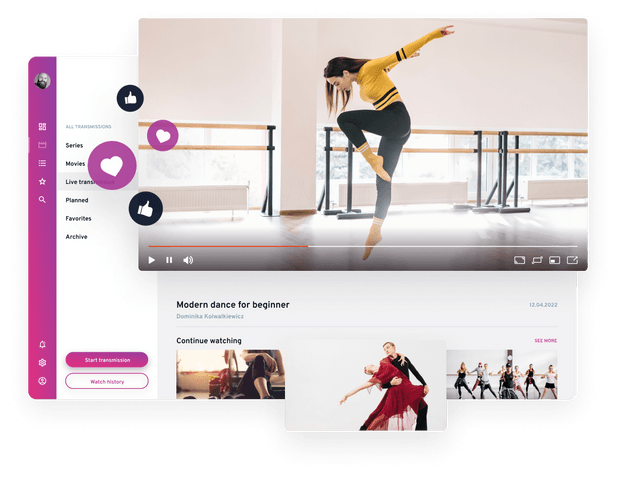
Video on Demand
On-demand content libraries with organized navigation, search, and categorization — viewers watch what they want, when they want.
Engagement & Rating
User ratings, reactions, and feedback mechanisms that measure content quality and drive recommendations.
Interactive Features
Screen annotations, filters, reactions, and interactive overlays that transform passive viewing into active participation.
Live Broadcasting
Multi-user live streaming with scheduling, concurrent broadcast support, and automatic archiving for replay.
Live Chat & Messaging
Real-time chat during broadcasts — enabling audience interaction, Q&A sessions, and community engagement.
AI-Powered AssistantTalk to MR. Agent: Your AI Sales Consultant
Get instant answers about our services, estimate your project, or connect with our team. MR. Agent is available 24/7 to help you explore how Mobile Reality can bring your ideas to life.
Industries that benefit most from streaming
Streaming solutions drive revenue and engagement across entertainment, education, healthcare, and commerce. Here's where we've seen the biggest impact.
Retail & E-commerce
Live product demos, real-time Q&A sessions, and shoppable streams that let viewers purchase while watching. Live commerce is the fastest-growing channel for direct-to-consumer brands.
Real Estate & PropTech
Virtual property tours, live open houses, and interactive walkthroughs that let prospective buyers explore properties remotely — with location data, pricing, and neighborhood info available in-app.
B2B & Education
Live webinars, online courses, and interactive training sessions that reduce the distance between provider and audience. Enable real-time Q&A, material sharing, and audience engagement for businesses that don't engage the public directly.
Healthcare & Telemedicine
Patient consultations, medical training, intern education, professional conferences, and clinical presentations — all delivered through secure, HIPAA-aware streaming infrastructure.
Production-grade streaming solutions
Full-stack streaming development — from backend media pipelines and CDN configuration to mobile and web player interfaces. Combined with our expertise in data analytics and machine learning, we build streaming platforms that are smart, scalable, and optimized for engagement.

Streaming Case Studies
Explore our streaming projects — from live dance classes with BoxCast integration to music distribution platforms with NFT minting. See how we've built scalable streaming solutions for global audiences.


Audio/Video Software Development – Frequently Asked Questions
Modern A/V software development goes beyond basic playback. Production-grade systems handle real-time encoding and transcoding (FFmpeg, AWS MediaConvert, Mux), adaptive bitrate streaming (HLS, DASH, Low-Latency HLS / WebRTC for sub-second latency), DRM and content protection (Widevine, FairPlay, PlayReady), media metadata pipelines (ID3, EXIF, ML-based tagging), and cross-device playback on web, mobile (iOS / Android), smart TVs, and embedded players. Backend infra usually combines object storage (S3), CDN (CloudFront, Cloudflare Stream), and queue-driven workers for ingest, conversion, and delivery.
On-demand (VOD) is essentially file delivery: encode once, store on S3, serve via CDN with HLS/DASH manifests. Pause / scrub / resume are trivial, and CDN caching handles scale. Live streaming is harder — it requires real-time ingest (RTMP, WebRTC, SRT), just-in-time encoding with sub-3-second latency targets, scaling under spike load, and a recording pipeline that converts the live session to the VOD archive. Stream health monitoring, fallback streams, and multi-bitrate ladders are baseline requirements. AWS IVS, Mux, and Cloudflare Stream offer managed live infrastructure if building from scratch is not the differentiator.
Content protection is layered. (1) Signed URLs with short TTLs (CloudFront / S3) so direct manifest links expire. (2) DRM for premium content — Widevine for Chrome / Android, FairPlay for Safari / iOS, PlayReady for Edge / consoles, all delivered via a license server (e.g., AWS Elemental MediaPackage, Axinom, EZDRM). (3) Forensic watermarking for high-value VOD so leaked copies trace back to the user. (4) Token-based playback authorization so the player must request a session before HLS playback starts. The trade-off: heavy DRM hurts startup time and limits browser compatibility — match protection level to content value.
A common 2026 stack: React on web with a professional player (Video.js, Shaka Player, or HLS.js for custom UIs), React Native for iOS / Android sharing types and API clients with web. Backend on Node.js / NestJS, with FFmpeg or managed services (AWS MediaConvert, Mux, Cloudflare Stream) for encoding. Storage on S3, delivery via CloudFront or Cloudflare CDN with signed URLs. Background workers (SQS + Lambda or ECS) for ingest jobs, transcoding, thumbnail generation, AI captioning. For real-time use cases (live calls, broadcasts) — WebRTC or LiveKit on top.
AI is becoming table-stakes for A/V in 2026. The standard set: automatic transcription and captions (OpenAI Whisper, AssemblyAI, AWS Transcribe) generated on upload and stored as WebVTT alongside the video. Semantic search over transcripts using vector embeddings, so users can find a moment by meaning, not keywords. Auto-chapters and summaries from LLMs (Claude, GPT) for long-form content. Content moderation on uploaded media (AWS Rekognition, Hive). Voice cloning and synthesis (ElevenLabs) for localization and accessibility. Pipelines run async (queue-driven) because models are too slow for the upload critical path.
Start your AI agent project today
Request a call today and get free consultation about your custom software solution with our specialists. First working demo just in 7 days from the project kick‑off.
Matt Sadowski
CEO of Mobile Reality