LETEMPICKLetempick: Audience Voting and Survey Platform for Real-Time Feedback
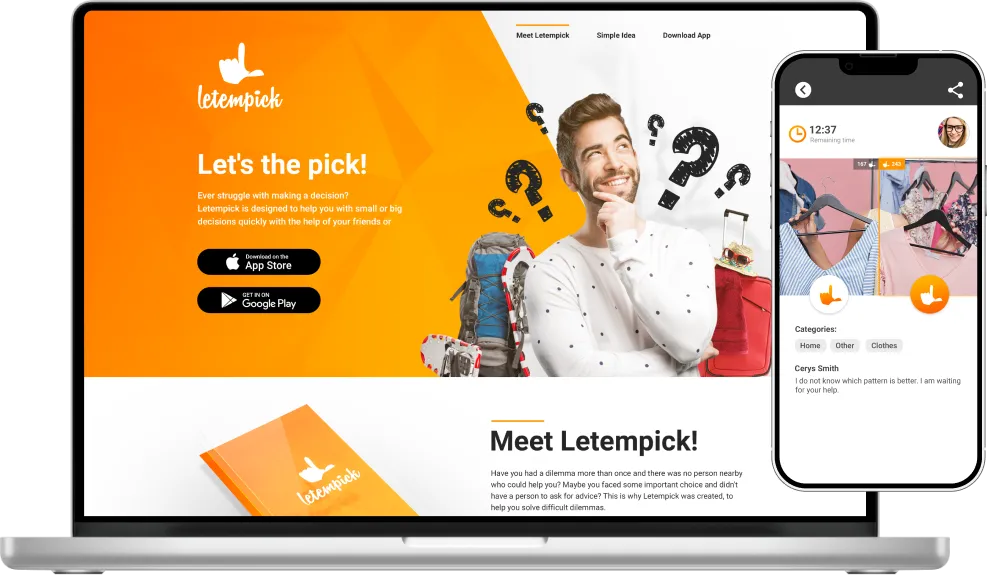
Letempick is a custom audience voting and survey platform that transforms how feedback is gathered and decisions are made. Beyond traditional surveys, the platform enables real-time audience voting, allowing users to express preferences, compare options visually, and help creators choose the best direction through engaging, interactive polls.
Scope of work
Web development
Mobile development
AWS Cloud
React JS
React Native
UX/UI Design
Building Surveys in Minutes
Our goal was to develop a custom online survey tool that makes creating and participating in polls effortless. Letempick's survey builder provides an intuitive interface for constructing visual polls and surveys, with clear navigation and straightforward workflows designed for both casual users and professional researchers.
The platform prioritizes user experience at every level, from the clean survey creation interface to the engaging voting experience for participants. Whether for business customer insights, community feedback, or creative decision-making, Letempick provides a versatile polling platform that makes every voice count.
Real-Time Voting at Scale
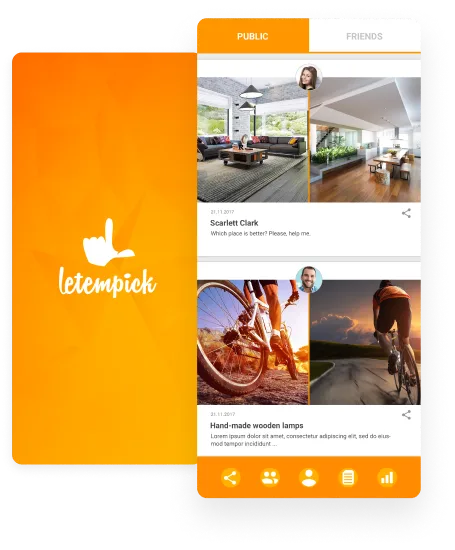
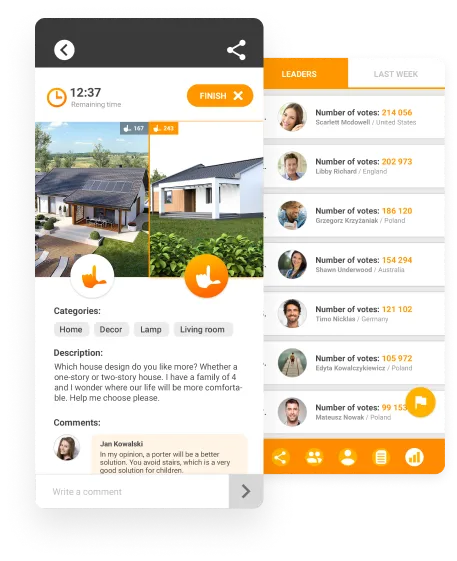
The core challenge was building a real-time voting engine that captures and presents results instantly as participants submit their responses. The system needed to handle concurrent voters, prevent duplicate submissions, and display live results with engaging data visualizations.

Expertises
Custom Software Development
Location
United Kingdom
Accessible Surveys for Everyone
The primary goal was to create a comprehensive survey platform accessible to everyone, from individual creators seeking community feedback to businesses running market research. The tool needed to compete with established solutions by offering a more engaging, visual approach to audience polling.
We aimed to deliver real-time analytics that turn raw responses into actionable insights. The dashboard needed to present data in an informative and visually engaging way, enabling quick interpretation and data-driven decision-making.
React, React Native & AWS Architecture
The web application was built with React.js for a responsive, interactive survey creation and management interface. The mobile experience uses React Native for cross-platform voting participation on iOS and Android.
The backend runs on Node.js with real-time capabilities for live vote counting and result updates. The infrastructure is hosted on AWS, providing the scalability needed to handle traffic spikes when popular surveys attract large numbers of concurrent participants.
The UX/UI design focuses on making surveys visually engaging: clean layouts, intuitive navigation, and interactive result visualizations that keep participants motivated to complete surveys and return for future polls.

Summary
We delivered a custom audience voting and survey platform that combines the ease of quick polls with the depth of structured surveys. Letempick enables creators, businesses, and communities to gather meaningful feedback through an engaging, real-time voting experience.
Built with React.js, React Native, Node.js, and AWS, the platform provides a modern alternative to traditional survey tools, prioritizing visual engagement, real-time results, and cross-platform accessibility.

Start your AI agent project today
Request a call today and get free consultation about your custom software solution with our specialists. First working demo just in 7 days from the project kick‑off.
Matt Sadowski
CEO of Mobile Reality

Case studies
Explore our past successes and see our expertise in action with our custom software development case studies. Discover how we've helped various industries drive growth and success from mobile apps to data analysis.



Frequently Asked Questions
Generic form builders (Typeform, Google Forms) collect responses one at a time. A real audience voting platform handles real-time aggregation with sub-second result updates, supports live event use cases (conference Q&A, classroom polls, town halls), enforces one-vote-per-user with abuse controls, and exposes a presenter view that updates as votes arrive. The hard parts are concurrency (thousands of votes per second), abuse prevention, and a UI that feels instant.
Layered defense: device fingerprinting (browser + IP signal) for casual abuse; rate limiting per IP and per fingerprint; CAPTCHA only when signals are suspicious so honest voters don't see friction; for higher-stakes votes, email or SMS verification at the moment of voting (no account required). For corporate or classroom contexts, single-use room codes or magic links provide a friction-free trust layer.
Read fan-out is the bottleneck, not writes. The pattern: votes write to a queue (SQS, Kafka), aggregator workers update Redis counters, and result pages subscribe via WebSocket or Server-Sent Events to the aggregator. The presenter view shows live counts pushed every 250–500ms; the database receives bulk writes asynchronously. This decouples the user-facing latency from durable storage.
Beyond multiple-choice: ranking (drag to reorder), weighted distribution (assign N points across options), open text with sentiment analysis, image-based polls (choose by photo), matrix questions for surveys, and NPS / CSAT presets with built-in calculation. Visual variety keeps respondents engaged — completion rates drop sharply on long surveys with one question type repeated.
Web is React; mobile is React Native (single team, shared types and API client); the backend is Node.js with REST plus a WebSocket layer for live results. PostgreSQL stores survey definitions and durable responses; Redis handles real-time aggregation. AWS for hosting (ECS or Fargate, RDS, ElastiCache, CloudFront). The survey builder itself is a heavy frontend component — invest in a clean schema and treat it as the platform's core data model.